
Every per sq ft rate hides a long list of materials: cement, steel, sand, aggregate, blocks, tiles, pipes, wires, doors, windows and paint. Together, they are the largest share of what you pay to build.
Understanding house construction material cost helps in two ways. It lets you check whether a quote is realistic, and it shows you where changes in specification actually move the budget.
This guide covers what materials make up the cost, 2026 prices in Bengaluru, how much material a typical home needs, a worked estimate for a G+1, how materials line up with each construction stage, and how to check quality and save without cutting corners.
What Makes Up House Construction Material Cost
Materials fall into five groups. Published Bengaluru cost guides put their shares of total construction cost roughly as shown.

The five main material groups behind a Bengaluru home: structure, walls, services, finishes and openings.
| Group | Main materials | Typical share of construction cost |
|---|---|---|
| Structure | Steel, cement, sand, aggregate, ready-mix concrete | Largest group; steel and cement alone are 30 to 40% of material cost |
| Walls | AAC blocks, solid concrete blocks, fly ash or clay bricks, plaster | Varies with block type and wall area |
| Services | Electrical wires, switches, conduits, water and drainage pipes | About 12 to 18% |
| Finishes | Floor and wall tiles, stone, paint, putty | Flooring about 10 to 15%; painting about 5 to 8% |
| Openings | Door frames and shutters, windows, grills, hardware | About 8 to 10% |
Overall, materials account for about 50 to 60 percent of construction cost and labour for about 20 to 30 percent, with supervision, overheads and margin making up the rest.
Construction Material Cost Per Square Foot
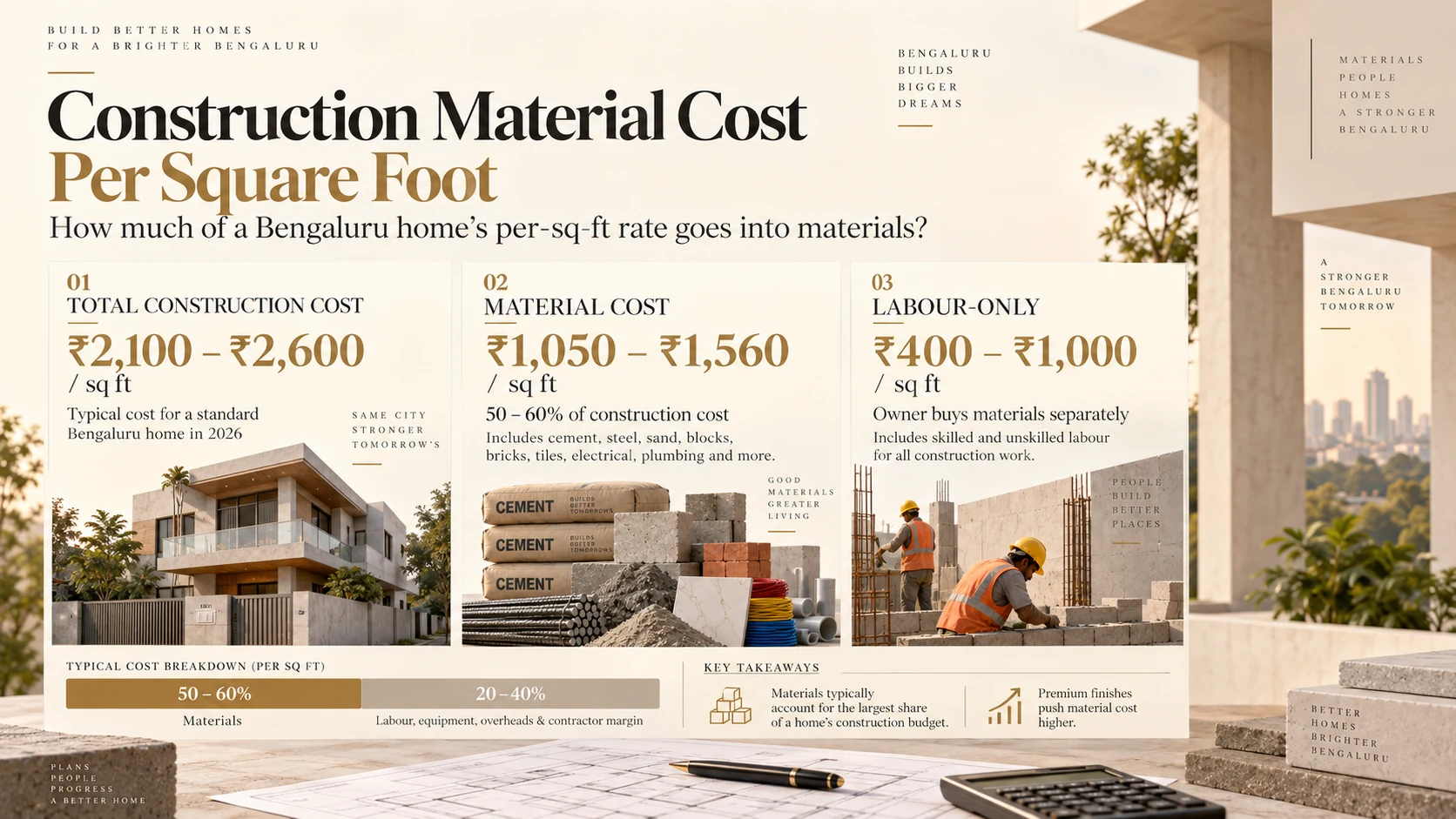
For a standard Bengaluru home, materials typically form the largest share of the per-square-foot construction rate.
If a standard home in Bengaluru costs ₹2,100 to ₹2,600 per sq ft to build, and materials are 50 to 60 percent of that, the construction material cost per square foot works out to roughly ₹1,050 to ₹1,560. Premium packages push this higher, because tiles, fittings and windows cost more while labour changes less.
Residential construction cost per sq ft without material
Some owners hire labour-only contractors and buy materials themselves. In Bengaluru, labour-only rates are commonly quoted at around ₹400 to ₹1,000 per sq ft, depending on skill and scope. The saving looks large on paper, but wastage, price swings, storage and quality checks become your responsibility.
Materials are only one part of the budget. Our guide to house construction cost in Bangalore shows how design fees, interiors and approvals add up to the full cost of a finished home.
Construction Material Cost in Bangalore: 2026 Prices
These are indicative Bengaluru prices from the supplied August 2026 tracker snapshot, with tile prices from a local supplier guide. Prices vary by brand, quantity and dealer, so confirm before you order.
| Material | Unit | Price in Bengaluru (2026) |
|---|---|---|
| OPC 53 grade cement | 50 kg bag | ₹433 to ₹476 |
| OPC 43 grade cement | 50 kg bag | ₹412 to ₹455 |
| PPC cement | 50 kg bag | ₹391 to ₹433 |
| TMT steel Fe500D, 8 mm | per kg | ₹70 to ₹82 |
| TMT steel Fe500D, 12 mm | per kg | ₹66 to ₹78 |
| TMT steel Fe500D, 16 to 20 mm | per kg | ₹68 to ₹80 |
| M-sand | per tonne | ₹1,100 to ₹1,400 |
| River sand | per tonne | ₹1,700 to ₹2,200 |
| Plastering sand (P-sand) | per tonne | ₹1,300 to ₹1,700 |
| Ready-mix concrete M20 | per cubic metre | ₹4,825 to ₹6,004 |
| Ready-mix concrete M25 | per cubic metre | ₹5,356 to ₹6,425 |
| Fly ash bricks | per piece | ₹6 to ₹8 |
| AAC blocks (600x200x200 mm) | per piece | ₹64 to ₹102 |
| Vitrified tiles, laid | per sq ft | ₹55 to ₹120 |
| Ceramic tiles, laid | per sq ft | ₹35 to ₹60 |
| Marble, laid | per sq ft | ₹150 to ₹250 |
How Much Material Does a House Need?
Rules of thumb help with early budgeting. The structural drawings decide the real quantities.
| Material | Rule of thumb | What changes it |
|---|---|---|
| Steel | About 3.5 to 4.5 kg per sq ft of built-up area | Number of floors, soil condition, spans and structural design |
| Cement | About 400 to 500 bags for a 1,000 sq ft single-floor RCC house | Use of ready-mix concrete, block type, plaster thickness |
| Steel wastage | Allow 3 to 5% for cutting | Bar lengths and how well cutting is planned |
For steel, the bar bending schedule (BBS) prepared from the structural drawings lists every bar by diameter and length. Order against the BBS rather than the rule of thumb, and you avoid both shortages and piles of unused steel.
House Construction Material Cost for a 1,900 Sq Ft G+1
Here is an illustrative estimate of the two biggest structural materials for a standard G+1 with about 1,900 sq ft built-up, using the rules of thumb and August 2026 Bengaluru prices.
| Material | Estimated quantity | Price used | Estimated cost |
|---|---|---|---|
| TMT steel | 6.7 to 8.6 tonnes (3.5 to 4.5 kg per sq ft) | ₹66 to ₹80 per kg | ₹4.4 lakh to ₹6.8 lakh |
| Cement | 760 to 950 bags (0.4 to 0.5 bags per sq ft) | ₹400 to ₹475 per bag | ₹3.0 lakh to ₹4.5 lakh |
| Steel and cement | ₹7.4 lakh to ₹11.3 lakh |
As a cross-check: at ₹2,300 per sq ft, construction on this home costs about ₹43.7 lakh. If materials are 50 to 60 percent of that, and steel and cement are 30 to 40 percent of materials, they come to roughly ₹6.6 lakh to ₹10.5 lakh, close to the estimate above.
Finishes add their own line. If about 1,500 sq ft of floor is tiled with vitrified tiles at ₹55 to ₹120 per sq ft laid, flooring alone comes to roughly ₹0.8 lakh to ₹1.8 lakh.
Materials Stage by Stage
Material spending is not spread evenly across the build. It is heaviest when the structure goes up.
| Stage | Main materials bought |
|---|---|
| Foundation | Steel, cement, aggregate, sand, anti-termite chemicals |
| RCC structure | Steel, cement or ready-mix concrete, shuttering, binding wire |
| Masonry | Blocks or bricks, cement, sand |
| Electrical and plumbing | Conduits, wires, boxes, water supply and drainage pipes |
| Plastering and waterproofing | Cement, plastering sand, waterproofing chemicals and membranes |
| Flooring, doors and windows | Tiles or stone, adhesive, frames, shutters, windows, hardware |
| Painting and fixtures | Putty, primer, paint, switches, lights, sanitaryware, taps |
This is why payment schedules put larger amounts against the foundation and slabs.
House Construction Material Cost Calculator: Quick Method
- Take your built-up area. Use the total across all floors from your drawings.
- Estimate steel. Multiply the area by 3.5 to 4.5 kg, then by the current price per kg.
- Estimate cement. Multiply the area by 0.4 to 0.5 bags, then by the current price per bag.
- Estimate flooring. Take about 80 percent of built-up area as tiled floor, then multiply by your tile rate.
- Cross-check the total. Materials overall should land near 50 to 60 percent of your construction rate multiplied by area. If your figures are far off, revisit the quantities.
Replace every rule of thumb with measured quantities once your bill of quantities is ready.
Why Material Prices Move
- Steel. TMT prices follow iron ore, coal, fuel and freight costs. On a 1,900 sq ft G+1, a ₹5 per kg move changes the steel bill by roughly ₹33,000 to ₹43,000.
- Cement. Prices shift with fuel, freight and demand. Bengaluru's cement comes largely from plants in north Karnataka, so transport costs matter.
- Sand and aggregate. Quarry supply around Bengaluru is periodically tightened by enforcement against illegal quarrying.
- Order size. Bulk steel orders of 10 tonnes or more often attract discounts of 2 to 4 percent.
A fixed-rate package with a clear escalation clause protects you from these swings. If you buy materials yourself, plan purchases by stage rather than at the last minute.
How to Check Material Quality
- Look for the ISI mark. Cement is covered by IS 269 and TMT steel by IS 1786. Ask for invoices that show brand and grade.
- Check the cement date. Use cement ideally within three months of manufacture, and store bags off the floor in a dry area, using the oldest first.
- Check steel markings. Bars should carry the brand and grade, such as Fe500D, and come with a mill test certificate.
- Check sand. M-sand for concrete should meet IS 383, and plastering sand should be used for plaster.
- Match brands to the specification. Before releasing each stage payment, confirm the materials on site match the brands and grades in your contract.
Smart Ways to Save on Materials
- Use M-sand for concrete. In Bengaluru it costs about ₹1,100 to ₹1,400 per tonne against ₹1,700 to ₹2,200 for river sand, roughly a third less.
- Order to the BBS. Buying steel against measured quantities avoids excess stock and wastage.
- Choose blocks with your engineer. Fly ash bricks are inexpensive per piece, while AAC blocks reduce structural load and speed up masonry.
- Spend on finishes selectively. Use premium tiles in the living areas and standard ones in utility spaces.
Frequently Asked Questions
What is the house construction material cost per sq ft?
For a standard home in Bengaluru, materials account for about 50 to 60 percent of the ₹2,100 to ₹2,600 construction rate, or roughly ₹1,050 to ₹1,560 per sq ft in 2026. Premium finishes raise the figure, because tiles, fittings and windows cost more.
How much steel is needed per sq ft for a house?
A conventional RCC frame house typically uses about 3.5 to 4.5 kg of steel per sq ft of built-up area, depending on floors, soil and spans. The structural engineer's bar bending schedule gives the exact figure, so order against it and allow 3 to 5 percent for cutting.
How many cement bags are needed for a 1,000 sq ft house?
A 1,000 sq ft single-floor RCC house typically needs about 400 to 500 bags of cement, covering foundation, frame, masonry and plastering. Using ready-mix concrete for slabs changes how much cement you buy directly, so estimate against your actual construction method.
What is the cement price in Bangalore in 2026?
In August 2026, OPC 53 grade cement in Bengaluru cost about ₹433 to ₹476 per 50 kg bag, OPC 43 about ₹412 to ₹455 and PPC about ₹391 to ₹433. Prices vary by brand and order size, so confirm with dealers before buying.
What is the residential construction cost per sq ft without material?
In a labour-only contract, you buy materials and the contractor charges only for work, commonly around ₹400 to ₹1,000 per sq ft in Bengaluru depending on skill and scope. It looks cheaper, but wastage, price swings and quality control become your responsibility.
Is M-sand cheaper than river sand in Bangalore?
Yes. 2026 price data puts M-sand in Bengaluru at about ₹1,100 to ₹1,400 per tonne, against ₹1,700 to ₹2,200 for river sand. M-sand meeting IS 383 is widely used for concrete, while plastering sand is sold separately for plaster work.
Should I buy construction materials myself or through the builder?
Buying yourself can save the builder's margin, but you take on price risk, wastage, storage and quality checks. A package with named brands and fixed rates shifts those risks to the builder. Either way, insist on invoices, ISI marks and checks before materials are used.
Conclusion
Materials are the largest part of what you pay to build, and steel and cement lead the list. Knowing prices, quantities and where they fall in the build lets you test quotes, time purchases and spot changes that genuinely move the budget.
Estimate with rules of thumb early, switch to measured quantities as soon as drawings are ready, and check brands and grades on site before every payment. That keeps material cost predictable and quality intact.
Know What Goes Into Your Home
Dwara Constructions handles architecture, construction and interiors with one in-house team, and has delivered 150+ projects across Mysuru and Bengaluru since 2016.
Share your plot details, and we will walk you through the specification and material plan for your home, brand by brand.
Share Your Plot Details