
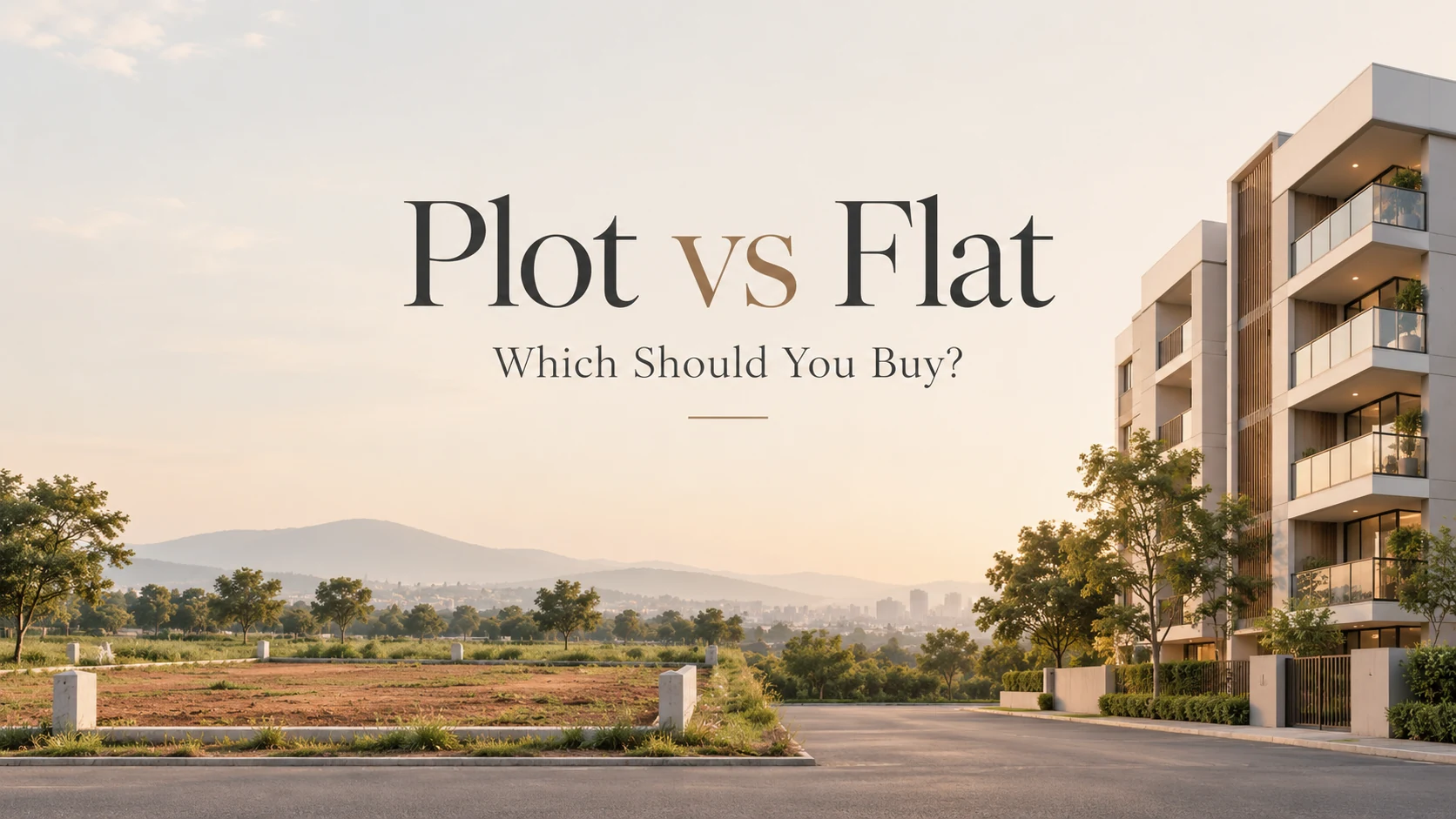
If you are choosing between land and an apartment, the decision is not only about price. It changes what you own, how much control you have, how the purchase is financed and what responsibilities you take on after buying.
This guide explains the difference between plot and flat on ownership, cost, loans, appreciation, legal checks and daily living so you can decide which fits your budget and plans.
What Is a Plot and What Is a Flat?
A plot is a measured piece of land with clear boundaries, sold without a building on it. A flat is a self-contained home on one floor of a multi-unit building, sold with a proportionate share of the common land and facilities. The words are simple, but the ownership structure is very different.
Plot
You get the land title in your name. You decide the house design, timing of construction and how much to build within the permitted FAR and other local planning rules. Plots may be sold in approved layouts, gated plotted developments or as standalone sites.
Flat
You get the title to your unit and an undivided share of the land, often shown as UDS in the sale deed. The builder designs and constructs the building, while common areas such as the lift, staircase, parking, clubhouse and garden are shared and maintained collectively.
In ordinary Indian real-estate usage, “flat” and “apartment” are generally used for the same type of home: one residential unit inside a building containing multiple homes.
Plot vs Flat: Side-by-Side Comparison
A plot is stronger on control, land ownership and long-term flexibility. A flat is stronger on convenience, security, amenities and easier financing.
| Factor | Plot | Flat |
|---|---|---|
| What you own | Full land title | Your unit plus an undivided share of land |
| Design control | You design and build within local rules | Fixed by the builder |
| Time to move in | After construction, often 12 to 24 months in the source draft | Immediately if ready, or on project completion |
| Upfront GST | None on land sale in the draft | Draft states 5% on under-construction flats, 1% if qualifying affordable housing, and none after OC |
| Home loan | Plot loans usually fund a smaller share and use shorter tenure | Home loans generally fund a larger share and can run longer |
| Tax benefits | Draft says plot-loan benefits generally begin only after a house is completed | Home-loan benefits begin from possession under the rules cited in the source |
| Monthly maintenance | Low; you maintain your own property | Regular association charges |
| Amenities | None unless part of a gated plotted development | Often lift, parking, security, clubhouse or gym |
| Security | Your responsibility | Shared, usually managed by the project or association |
| Value over time | Driven strongly by land value | Depends on location, building age and upkeep |
| Resale | Depends on location, title and layout approval | Often easier in established projects; harder as buildings age |
| Main legal risk | Unapproved layout, unclear title, encroachment | Project delay, sanctioned-plan deviation, missing OC |
Cost Difference Between Plot and Flat
A plot can cost less to purchase but more to finance because lenders usually fund a smaller share, and you still have to pay for construction. A flat can cost more upfront as a completed product, but standard home-loan financing is generally easier.
Down payment and loans
The source draft uses about 70 percent as a typical plot-loan funding level and 75 to 90 percent for flat home loans. It also notes that plot-loan tenures are shorter than standard home loans, which can mean a higher EMI for the same borrowed amount.
Tax benefits
Under the old-tax-regime treatment described in the source, deductions on a plot loan do not apply while the land remains empty, and home-construction conditions must be met before the relevant benefits begin. A home loan for a completed flat can qualify from possession under the cited rules.
GST
The draft states that sale of land is outside GST. It uses 5 percent GST for an under-construction flat, 1 percent for qualifying affordable housing, and no GST on a ready flat after the occupancy certificate is issued.
Stamp duty and registration in Karnataka
The source draft states that plots and flats pay stamp duty and a registration fee, with the fee calculated on the higher of sale consideration and the applicable guidance value. These rates are among the figures the draft itself says should be rechecked periodically.
Illustrative example: ₹50 lakh plot vs ₹50 lakh under-construction flat
| Cost item | Plot | Flat (under construction) |
|---|---|---|
| Typical down payment used in the draft | About ₹15 lakh at 70% loan funding | About ₹10 lakh at 80% loan funding |
| GST | Nil in the example | About ₹2.5 lakh at 5% |
| Registration fee example | ₹1 lakh at the draft's 2% assumption | ₹1 lakh at the draft's 2% assumption |
| Construction cost | Extra, paid separately | Included in purchase price |
| Monthly maintenance | Low | Association charges apply |
Appreciation and Resale: Which Grows in Value?
The draft's main argument is that land often has stronger appreciation potential because land is limited, while the physical building component of a flat ages. But that does not make every plot a better investment.
A peripheral plot can remain idle for years if roads, water and power develop slowly. A flat in a strong, connected location can hold value well and generate rent immediately, while an empty plot produces no rental income until it is developed.
Plots tend to do better when
- The layout is approved and title is clean
- New roads, ring roads or transit are planned nearby
- The plot has good road access and favourable development potential
Flats tend to hold value better when
- The project is close to offices, schools and hospitals
- The builder has a track record of delivery
- The building and common areas are maintained well
Legal Checks Before You Buy a Plot or a Flat
The legal risks are different. For a plot, the major concerns are unclear title and unapproved layouts. For a flat, the major concerns are project delays, sanctioned-plan deviations and occupancy status.
| Check | Plot | Flat |
|---|---|---|
| Title deed and ownership chain | Yes; the draft recommends tracing back at least 30 years | Yes, for the project land |
| Encumbrance Certificate (EC) | Yes, to check loans or disputes | Yes, for project land and unit |
| Khata or e-Swathu | Yes, in the seller's name | Yes, for the unit after registration |
| Land conversion order | Required if the land was agricultural | The developer should hold the required conversion for the project |
| Layout approval | Critical: MUDA in Mysuru, or the relevant planning authority elsewhere | Not applicable as a plotted-layout check |
| RERA registration | Applicable to qualifying plotted developments under the draft's stated thresholds | Applicable to qualifying apartment projects under the draft's stated thresholds |
| Sanctioned building plan | Relevant when you later build | Yes; constructed floors should match the sanction |
| Occupancy Certificate | Relevant after your house is built where applicable | Important before occupation where applicable |
| Undivided share of land (UDS) | Not applicable | Should be stated in the sale deed |
For Mysuru buyers, the source draft makes one point very clearly: a plot in a MUDA-approved layout is generally easier to finance and resell than a plot in a revenue layout. Approval should be verified before an advance is paid.
Plot or Flat: Which Is Right for You?
The choice usually comes down to control, time and financing.
A plot suits you if you
- Want to design your own home and possibly add floors later
- Can wait roughly 12 to 24 months to build
- Have enough savings for a larger down payment plus construction
- See land as a long-term family asset
- Are comfortable managing approvals and construction, or will appoint a builder
A flat suits you if you
- Need to move in soon or want rental income quickly
- Prefer security, lifts and shared amenities
- Want a smaller upfront contribution and longer loan tenure
- Do not want to manage construction
- Are buying in a dense city area where plots are limited or costly
The draft also highlights a middle path that suits many Mysuru families: buy a plot in an approved layout, then use a design-build firm to handle the house. This keeps land ownership and custom design while reducing the burden of coordinating every contractor.
Frequently Asked Questions
What is the difference between plot and flat?
A plot is a piece of land you own outright and can build on. A flat is one home inside a shared building, owned with an undivided share of the land underneath. A plot gives you design control and full land ownership. A flat gives you a ready home, shared amenities and easier financing.
Which is a better investment, a plot or a flat?
The source draft favours approved, well-connected plots for long-term land-value potential, while flats offer earlier rental income and easier financing. The better choice depends on location, title quality, project quality and how soon you need the property to generate use or income.
Is it cheaper to buy a plot or a flat?
A plot can cost less at purchase but usually needs a larger down payment and separate construction spending. A flat generally needs a smaller upfront contribution through standard home-loan financing, while an under-construction flat may attract GST.
Can I get a home loan for a plot?
Yes, through a plot loan or a composite loan for land plus construction. The supplied draft notes that lenders usually fund a smaller share of plot value and offer shorter tenures than standard home loans, sometimes with a requirement to build within a specified period.
Is GST charged on plots?
The supplied draft states that sale of land is outside GST. It also states that under-construction flats attract GST and ready flats with an occupancy certificate do not. Confirm the applicable tax treatment at the time of purchase.
What is UDS in a flat?
UDS stands for undivided share of land. It is the proportion of the project's land that legally belongs to you along with your flat. It is not separately marked on the ground, but it should be stated in the sale deed.
Which is easier to resell, a plot or a flat?
A flat in a well-kept established project can be easier to resell quickly. A plot can resell strongly when it is in an approved layout with clear title and good road access. Unapproved or revenue-layout plots can be difficult for future buyers to finance.
The Bottom Line on Plot vs Flat
The plot and flat difference comes down to control versus convenience. A plot gives you land, freedom to design and long-term flexibility, but needs more money upfront and time to build. A flat gives you a ready home, shared amenities and easier financing, but less design control and recurring common-area costs.
Whichever direction you lean, the more important decision is buying the right property: an approved layout or project, clean title and documentation, and a development you can finance and use comfortably.
Buy the Plot With the House in Mind
Dwara Constructions handles architecture, construction and interiors with one in-house team, and has delivered 150+ projects across Mysuru and Bengaluru since 2016.
If you are considering a plot in Mysuru, share the site details with us. We can help you understand the layout, permitted FAR and what kind of home the plot can support before you move into design.
Share Your Plot Details